
Free Google Ranking: How to Appear at the Top Without Spending a Dime (The 80/20 Rule Explained)
In today’s digital landscape, visibility on Google is paramount for business success. Yet, the perception often is that achieving top rankings requires significant financial investment. This guide dismantles that myth, revealing how to harness the power of free Google ranking to drive traffic, generate leads, and boost sales.
We’ll explore effective strategies, underpinned by the Pareto Principle – the 80/20 rule – to help you focus your efforts on what truly matters, maximizing your return without spending a dime. Almost half (49%) of business owners felt that SEO offered the best return-on-investment (ROI) of all channels (Search Engine Journal, 2025), highlighting the immense value of a well-executed, cost-effective search engine optimization strategy.
The Power of Free Google Ranking for Your Business
Securing a prominent position in Google’s search results is akin to having a prime storefront on the busiest street in the digital world. Free Google ranking, achieved through organic SEO efforts, builds sustained credibility and trust with potential customers. Unlike paid advertisements that cease to deliver traffic when the budget runs out, organic rankings are a long-term asset.
They attract highly targeted traffic from people actively searching for your products or services, leading to higher conversion rates and ultimately, increased sales. For small businesses or those with limited marketing budgets, mastering free SEO is not just an option; it’s a crucial pathway to competing effectively and achieving sustainable business growth.
Introducing the 80/20 Rule (Pareto Principle) for SEO Success
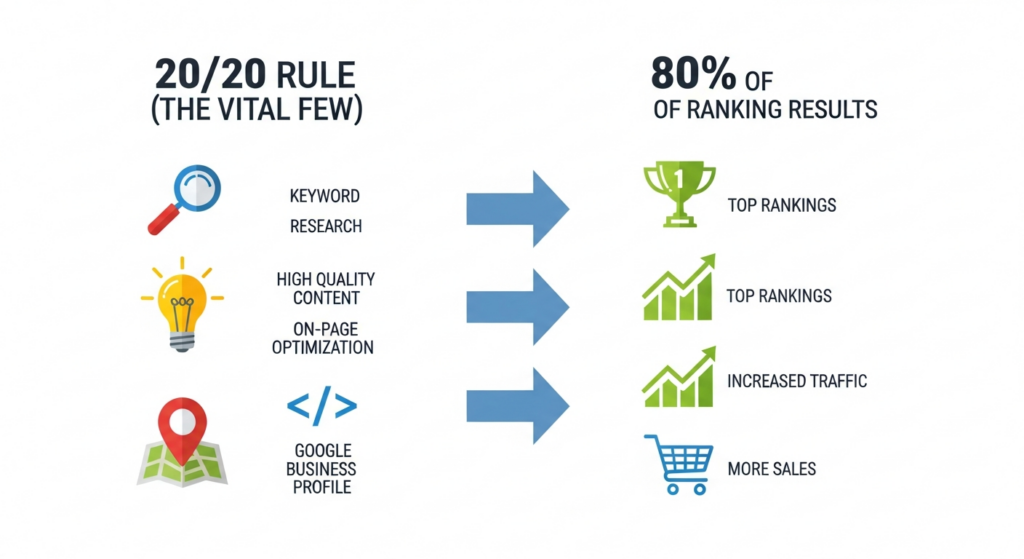
The 80/20 rule suggests that a small number of high-impact SEO activities generate the majority of your ranking success.
The 80/20 rule, also known as the Pareto Principle, posits that roughly 80% of effects come from 20% of causes. In the realm of search engine optimization (SEO), this principle is a powerful framework for efficiency. It suggests that a select few SEO activities will yield the vast majority of your results. Without a budget, this rule becomes indispensable.
It guides you to identify and prioritize those high-impact, low-cost strategies that deliver the most significant improvements in your Google rankings, helping you avoid the trap of spending time and energy on efforts that yield minimal returns.
What This Guide Will Cover: Focused, Free, and Effective Strategies
This guide will equip you with a strategic roadmap for achieving top Google rankings without any financial outlay. We will demystify the 80/20 rule in the context of SEO, focusing on how to identify the “vital few” free tactics that drive the majority of results.
You will learn actionable strategies for mastering your Google Business Profile, conducting effective keyword research, creating compelling content, performing essential on-page optimization, and building credibility – all for free. We will also highlight how to leverage Google’s own suite of free tools to monitor your performance and identify areas for improvement, ensuring your efforts are always focused and effective.
The 80/20 Rule Explained: Prioritizing Your Free SEO Efforts
Understanding and applying the 80/20 rule is the cornerstone of effective free SEO. It’s about working smarter, not harder, by channeling your limited resources – primarily time and effort – into activities that generate the most significant impact on your Google rankings and overall business goals.
Understanding the Pareto Principle in Search Engine Optimization
The Pareto Principle in SEO means recognizing that not all SEO tasks are created equal. A small percentage of your SEO activities will be responsible for the majority of your organic traffic, leads, and sales. For businesses operating without a budget, this realization is critical.
It helps differentiate between tasks that move the needle and those that are merely busywork. By focusing on the 20% of efforts that deliver 80% of the results, you maximize your chances of success and ensure your time is invested wisely.
Identifying the “20%”: High-Impact, Low-Effort Free Tactics
The “vital 20%” for free SEO typically revolves around foundational elements that Google prioritizes. These often include optimizing your Google Business Profile for local search, creating high-quality, user-centric content, conducting smart keyword research, and ensuring your website is technically sound and user-friendly. These are the areas where concentrated effort, even without spending money, can lead to substantial improvements in search engine rankings and drive valuable traffic.
Why Focus on Free: Maximizing ROI Without a Budget
Focusing on free SEO strategies is about maximizing your return on investment (ROI) when financial resources are constrained. Paid advertising provides immediate results but at a continuous cost. Organic search, however, builds a sustainable asset that continues to deliver traffic and leads over time, often at a lower long-term cost.
By dedicating your time and focus to mastering free SEO tactics, you invest in a scalable and enduring source of business growth, directly impacting your bottom line.
The Myth of “Expensive SEO”: How to Get Results for Small Businesses
The notion that effective SEO is prohibitively expensive is a common misconception. While advanced SEO can involve paid tools and extensive agency fees, the core principles of good SEO are accessible to everyone.
Small businesses can achieve remarkable results by focusing on the fundamentals: understanding their audience, creating valuable content, and optimizing their online presence for search engines.
The key is to leverage free tools and a strategic approach that prioritizes impact over expenditure. In a 2025 industry survey, 91% of respondents said SEO improved website performance and marketing goals in 2024, rising to 97% among the most mature programmes (Search Engine Journal, 2026), demonstrating its effectiveness regardless of budget.
The Apex of Free SEO: Mastering Your Google Business Profile (The Core 20%)
Your Google Business Profile (GBP) is arguably the single most impactful free tool in your SEO arsenal, especially for businesses serving local customers. It’s your digital storefront on Google Search and Maps, directly influencing your visibility in local search results.
Why Your Google Business Profile (GBP) is Your #1 Free Ranking Factor
For local businesses, GBP is indispensable. When people search for products or services in their vicinity, Google often displays local pack results featuring GBP listings. A well-optimized profile significantly increases your chances of appearing in these coveted spots, driving immediate local traffic and potential sales. It’s a direct line to customers actively looking for what you offer, making its optimization a prime candidate for your SEO “20%”.
Step-by-Step: Claiming and Optimizing Your GBP for Local Search Results
Claiming and optimizing your GBP is a straightforward process. First, search for your business on Google and claim your listing, or create a new one. You’ll need to verify your business, typically via mail or phone. Once verified, complete every section of your profile meticulously: accurate business name, address, phone number (NAP), hours, website link, and categories. Ensure consistency across all your online listings.
Maximizing Engagement and Credibility Through GBP Features
Beyond basic information, leverage GBP’s features to enhance engagement and credibility. Utilize the “Posts” feature to share updates, offers, and events. Regularly add high-quality photos and videos of your business, products, and team.
The Q&A section is an opportunity to proactively address common customer queries, showcasing your expertise and responsiveness. Every interaction on your profile signals activity and relevance to Google.
The Gold Standard: Generating and Managing Customer Reviews
Customer reviews are a powerful ranking factor and a critical trust signal. Actively encourage satisfied customers to leave reviews on your GBP. Respond to all reviews, both positive and negative, professionally and promptly.
This engagement demonstrates excellent customer service and provides valuable feedback. A consistent stream of positive reviews significantly boosts your local search rankings and influences purchasing decisions.
Integrating Google Maps Marketing: Driving Local Traffic
A prominent listing on Google Maps is a direct result of GBP optimization. Ensure your business information is precise to facilitate accurate navigation for users. Encourage check-ins and photo uploads from customers.
By making your business easily discoverable and appealing on Google Maps, you directly attract local customers who are ready to engage with your business.
The 80/20 of Free Keyword Research: Finding What People Actually Search For
Effective keyword research is the foundation of any successful SEO strategy, free or paid. It’s about understanding the language your potential customers use when they search for solutions you provide.
Beyond Volume: Understanding Search Intent for High-Impact Keywords
While keyword volume indicates popularity, search intent is more crucial for driving meaningful results. People search for different reasons: to learn, to navigate, to find specific products, or to make a purchase. Identifying keywords that align with purchase intent or problem-solving needs ensures you attract visitors who are more likely to convert. Prioritizing keywords that match user intent is a key aspect of the 80/20 rule.
Unleashing Google’s Free Keyword Research Tools
Google provides several excellent free tools to help you discover relevant keywords. Use Google Search’s autocomplete suggestions, “People Also Ask” boxes, and “Related Searches” at the bottom of the results page. These offer real-time insights into what users are searching for. Google Trends can also reveal popular or emerging search terms related to your industry, helping you spot opportunities.
Focusing on Long-Tail Keywords: Less Competition, Higher Conversion Rates
Long-tail keywords are longer, more specific phrases (e.g., “best waterproof hiking boots for wide feet”). While they have lower search volumes individually, they often have higher conversion rates because they indicate a clear intent.
84.74% of keywords have monthly search volumes of 10 or less (Ahrefs, 2026), underscoring the significant opportunity in targeting these niche terms. Targeting long-tail keywords is a smart 80/20 strategy, as they are typically less competitive and attract highly qualified traffic.
80/20 Content Creation: Building Authority with Strategic Pages and Blog Posts
High-quality content is the engine of SEO. It answers user questions, establishes your expertise, and keeps visitors engaged. The 80/20 approach to content means focusing on creating a few pieces that truly resonate and perform, rather than a high volume of mediocre content.
Crafting “People-First” Content: Answering User Questions Directly
Google’s algorithms are designed to serve users. Therefore, your content should prioritize providing genuine value and answering the questions people are asking. Focus on clarity, comprehensiveness, and accuracy. When people find your content helpful and engaging, they are more likely to spend time on your site, share it, and return, signaling quality to Google.
Essential Website Content: The Foundation of Your Search Visibility
Every business needs foundational website content that clearly articulates what you do, who you serve, and how you help. This includes service or product pages, an “About Us” page, and contact information. These pages are critical for informing users and search engines about your business. Ensuring these core pages are well-optimized and informative is a high-impact free SEO task.
Leveraging Free AI Tools (like ChatGPT) for Content Ideation and Outlines
Free AI tools can be invaluable for overcoming writer’s block and generating content ideas. Use them to brainstorm blog post topics, create outlines, or even draft initial sections. Remember, AI is a tool to assist your creativity and research, not replace it. Always edit and refine AI-generated content to ensure accuracy, tone, and a unique human touch.
Basic Content Optimization for Free Ranking Power
Once content is created, optimize it for search engines. This involves naturally incorporating your target keywords into titles, headings, and body text. Write compelling meta descriptions that encourage clicks.
Ensure your content is easy to read with clear formatting, short paragraphs, and bullet points. Updating an existing title tag with an SEO optimized one can increase organic clicks by 437% (Safari Digital, 2026), demonstrating the significant impact of even minor optimizations.
The 80/20 of On-Page Optimization: Making Your Website Google-Friendly for Free
On-page optimization involves improving elements on your website itself to enhance its visibility in search results. These are technical and user experience aspects that you can largely manage without cost.
Website Speed and Mobile-Friendliness: Core Web Vitals for User Experience
Website speed and mobile-friendliness are critical ranking factors. Google prioritizes sites that offer a fast and seamless experience, especially on mobile devices. Use Google’s PageSpeed Insights and Mobile-Friendly Test tools to identify areas for improvement. Optimizing image sizes and leveraging browser caching are effective free strategies to boost performance.
Technical SEO Basics You Can Implement for Free
Technical SEO ensures search engines can crawl and index your site effectively. This includes creating an XML sitemap and submitting it to Google Search Console, ensuring proper use of header tags (H1, H2, etc.), and implementing clean URL structures. For content pages, attention to title tags and meta descriptions is vital for click-through rates.
User Experience (UX): Designing for People, Loved by Search Engines
A positive user experience (UX) is intrinsically linked to good SEO. If users find your website easy to navigate, visually appealing, and helpful, they are more likely to stay longer and engage more deeply.
This positive user behavior is a strong signal to Google that your site is valuable. Focus on intuitive navigation, clear calls to action, and a visually organized layout.
The 80/20 of Off-Page & Credibility Building: Earning Trust Without Spending
Off-page SEO refers to actions taken outside of your website to impact your rankings. For free SEO, this means building credibility and authority through legitimate means.
Local Citations and NAP Consistency
For local businesses, consistent NAP (Name, Address, Phone number) information across online directories and citation sites is crucial. Inaccurate or inconsistent information can confuse search engines and users. Ensure your business details are identical everywhere online.
Earning Natural Backlinks Through Valuable Content
While active link-building is costly, earning natural backlinks through exceptional content is a powerful free strategy. When other websites find your content valuable, they will link to it as a resource. Focus on creating in-depth guides, original research, or insightful articles that naturally attract attention and citations.
Leveraging Testimonials and Case Studies for Credibility
Showcasing customer testimonials and detailed case studies on your website is a potent way to build trust and credibility without spending money on external links. These authentic endorsements provide social proof and demonstrate the real-world value of your business.
Leveraging Google’s Free Tools for 80/20 Insights
Google offers a suite of powerful free tools that are essential for monitoring, analyzing, and improving your SEO performance.
Google Search Console: Your Performance Dashboard
Google Search Console is indispensable for understanding how your site performs in Google search. It provides data on search queries driving traffic, click-through rates, impressions, and identifies any technical issues or errors impacting your rankings. Use it to monitor your site’s health and identify opportunities for improvement.
Google Analytics: Understanding User Behavior
Google Analytics offers deep insights into your website traffic. You can track visitor sources, demographics, user behavior on your site, and conversion rates. This data helps you understand which pages are most popular, where users drop off, and how your SEO efforts are translating into actual business outcomes.
Google Alerts and Trends: Staying Informed and Ahead
Use Google Alerts to monitor mentions of your brand, competitors, or relevant industry keywords. This helps you stay informed about conversations and identify potential PR opportunities.
Google Trends provides data on search interest over time, helping you identify seasonal search trends and emerging topics, informing your content strategy.
What to Ignore: Low-Impact Free Efforts
In applying the 80/20 rule, it’s equally important to identify what to ignore. Not all SEO activities, even free ones, are created equal.
The Trap of “Busy Work” and Vanity Metrics
Avoid getting caught up in tasks that don’t directly contribute to tangible business results. Chasing vanity metrics, like a high number of social media followers that don’t translate to website traffic or sales, can be a time sink. Focus on metrics that directly impact your business goals, such as organic traffic, leads generated, and sales conversions.
Over-Optimization of Low-Impact Areas
Spreading your efforts too thinly across every possible SEO tactic can dilute your impact. For instance, spending excessive time on minor on-page tweaks for pages that receive very little traffic is often a poor use of resources. Stick to optimizing your most important pages and core business profiles first.
Complex Technical Audits for Small Businesses
While technical SEO is vital, overly complex and exhaustive technical audits can be overwhelming and unnecessary for small businesses without dedicated IT resources. Focus on addressing the most critical technical issues identified by Google Search Console, such as mobile-friendliness and site speed, rather than getting lost in minutiae.
Prioritizing Your Time
With the 80/20 rule as your guide, effective time management is key. Reiterate your focus on the core “20%” tactics: mastering your Google Business Profile, creating strategic, high-quality content, focusing on relevant long-tail keywords, and ensuring basic on-page optimization and technical health. Consistency in these high-impact areas will yield far better results than sporadic efforts across a wide range of low-impact activities.
Sustaining Free Google Rankings
Achieving top rankings is an ongoing process. Google’s algorithms evolve, and your competitors are always working. Continuously monitor your performance using Google’s free tools, stay updated on SEO best practices, and keep your content fresh and relevant. The “Learn” aspect of SEO is continuous, ensuring your efforts remain effective over the long term.
Conclusion
Achieving top Google rankings without spending a dime is not only possible but highly achievable by strategically applying the 80/20 rule. By prioritizing high-impact, low-cost tactics such as mastering your Google Business Profile, conducting smart keyword research, creating user-centric content, and ensuring essential on-page optimization, you can significantly enhance your business’s online visibility.
Focus on what truly drives results, leverage Google’s free tools to measure your performance, and consistently refine your approach.
Remember, SEO is a marathon, not a sprint, and a focused, free strategy is your most powerful asset for sustained business growth and increased sales.
In a 2025 industry survey, 91% of respondents said SEO improved website performance and marketing goals in 2024, rising to 97% among the most mature programmes (Search Engine Journal, 2026), reinforcing the enduring value of well-executed SEO.
Start implementing these strategies today and watch your free Google rankings soar.