
Startup Digital Marketing Roadmap: Marketing strategy
In today’s hyper-connected world, the digital landscape & Marketing strategy is both the greatest opportunity and the most significant challenge for emerging startups. Navigating this complex terrain without a clear map can lead to wasted resources, missed connections, and ultimately, stunted growth. This is where a robust digital marketing roadmap becomes indispensable.
It’s not just about executing a series of tactics; it’s about building a strategic, phased approach designed to guide your startup from initial concept to sustainable, scalable success.
This roadmap will provide the blueprint, enabling you to understand your audience, build a compelling brand, gain vital visibility, and continuously optimize your efforts for maximum impact.
The Digital Marketing Imperative for Modern Startups
For any modern startup, digital marketing is no longer an optional add-on but a foundational pillar of its growth strategy. The way consumers discover, research, and purchase products has fundamentally shifted online. A well-executed digital marketing strategy allows startups to reach their target audience efficiently, build brand awareness, and drive tangible conversions.
Without a strong online presence and a coherent digital marketing strategy, even the most innovative product can struggle to find its market. It provides a direct channel to engage with potential customers, gather invaluable feedback, and adapt quickly to market dynamics. Embracing digital marketing is not merely about staying relevant; it’s about actively shaping your startup’s trajectory and securing its competitive edge.
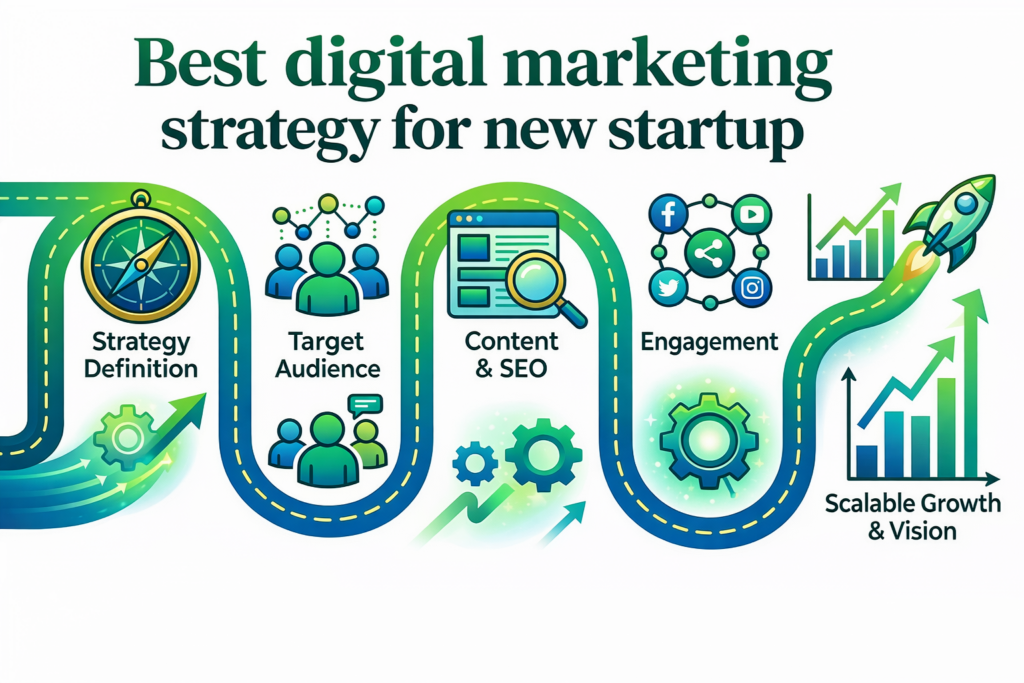
Why a Strategic Roadmap is Your Growth Compass
A strategic roadmap acts as your marketing compass, providing direction and clarity in an often-turbulent startup journey. It moves beyond a reactive approach of trying individual digital marketing tactics to a proactive, integrated plan.
This roadmap ensures that every marketing effort is aligned with overarching business objectives, allowing for more efficient allocation of resources, particularly crucial for startups with limited budgets.
It helps define clear goals and Key Performance Indicators (KPIs), enabling you to measure progress, identify what’s working, and pivot when necessary. Without a roadmap, efforts can become scattered, leading to a lack of focus and ultimately, diminished returns. A strategic roadmap transforms scattered actions into a cohesive, results-driven growth engine.
What This Roadmap Will Cover: A Phased Approach to Sustainable Growth
This roadmap outlines the four key phases of a startup’s digital marketing journey, from building a solid foundation to achieving sustainable growth.
This comprehensive roadmap is designed to guide your startup through four distinct phases, each building upon the last to foster sustainable and scalable growth. We will begin by laying a solid foundation, defining your core strategy and brand identity. This secure phase focuses on activating your digital marketing efforts to gain initial traction and visibility.
We will then delve into scaling and optimization, leveraging data to accelerate growth. Finally, we will explore strategies for long-term sustainability and future-proofing your digital marketing strategy. This phased approach ensures a logical progression, allowing you to master foundational elements before moving to more advanced tactics, ensuring your customer acquisition efforts are robust and your product resonates deeply.
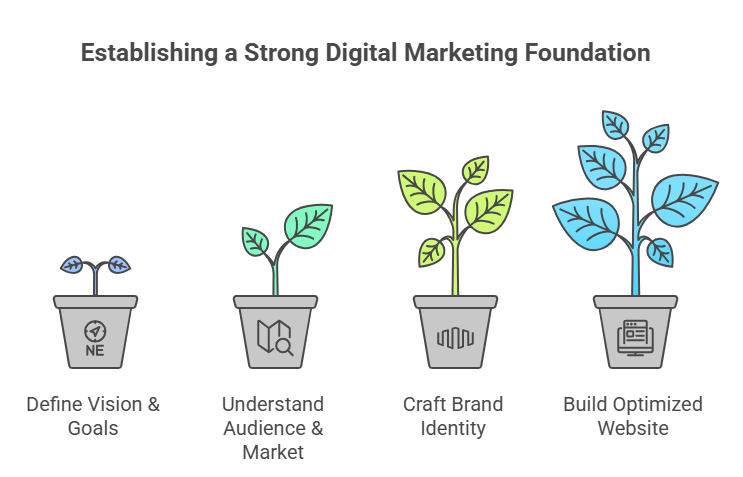
Phase 1: Laying the Foundation – Strategic Blueprint & Brand Identity
This initial phase is paramount for establishing a clear direction and a compelling identity for your startup. Without a strong foundation, subsequent marketing efforts will lack focus and impact, hindering your ability to connect with your target audience. This strategic blueprint requires a deep dive into understanding and strategic definition, setting the stage for all future marketing activities.
Defining Your North Star: Vision, Goals, and Key Performance Indicators (KPIs)
Every successful digital marketing strategy begins with a clear understanding of where you are going. Define your startup’s overarching vision and mission. Translate this into specific, measurable, achievable, relevant, and time-bound (SMART) goals. For instance, rather than a vague goal like “increase sales,” aim for “achieve a 15% increase in online sales within the next quarter.” Crucially, identify your Key Performance Indicators (KPIs).
These are the metrics that will tell you if you are on track. For startups, these might include customer acquisition cost (CAC), conversion rates, website traffic, brand awareness metrics, and ultimately, customer lifetime value (CLTV). A well-defined set of KPIs will serve as your performance barometer throughout your digital marketing journey.
Deep Dive into Your Target Audience and Market Landscape
Understanding your target audience is the bedrock of effective marketing. Go beyond basic demographics. Delve into psychographics, pain points, needs, desires, and online behaviors. Create detailed buyer personas that represent your ideal customer. Simultaneously, conduct thorough market research.
Analyze your competitors, identify market gaps, and understand the overall landscape. This deep insight will inform every aspect of your digital marketing strategy, from the messaging you use to the platforms you choose. A precise understanding of your customer and market ensures your product and marketing efforts are perfectly aligned.
Crafting Your Compelling Brand Identity and Value Proposition
Your brand identity is what sets you apart. It encompasses your mission, values, personality, and voice. Develop a unique selling proposition (USP) that clearly articulates the unique value your product offers to your target audience. This proposition must resonate with their needs and pain points, differentiating you from the competition.
Your brand identity should be consistently reflected across all digital marketing touchpoints, from your website to your social media profiles. A strong brand identity builds trust, fosters recognition, and lays the groundwork for lasting brand awareness.
Building Your Digital Headquarters: The Optimized Website
Your website is your primary digital storefront. It must be more than just a brochure; it needs to be a high-performing engine for customer acquisition and conversion. Focus on user experience (UX), ensuring it’s intuitive, mobile-responsive, and loads quickly. Implement clear calls-to-action (CTAs) that guide visitors towards desired outcomes.
Foundational search engine optimization (SEO) is critical from the start to ensure your site is discoverable. Prioritize security, especially if handling customer data. An optimized website is the central hub for all your digital marketing activities, providing a seamless experience for your customer and a reliable platform for generating leads and sales.
Phase 2: Activation & Initial Outreach – Gaining Visibility & Early Traction
With your foundation firmly in place, Phase 2 is about making noise and attracting your initial wave of customers. This phase involves deploying key digital marketing tactics to build visibility, drive traffic, and generate early engagement. It’s about translating your strategic blueprint into tangible results and beginning the customer acquisition process.
Igniting Organic Growth: Essential Search Engine Optimization (SEO) Foundations
Search engine optimization is vital for long-term, sustainable organic growth. Focus on keyword research to understand what your target audience is searching for on Google and other search engines. Implement on-page SEO by optimizing your website content, meta descriptions, and headers. Ensure your website has a solid technical SEO foundation, addressing site speed, mobile-friendliness, and crawlability.
For many startups, local SEO may also be important. By improving your website’s ranking on search engine results pages, you attract highly motivated users actively looking for solutions your product offers. In 2024, 91% of marketers reported that SEO enhanced their website performance and helped achieve marketing objectives.
Content that Connects: Storytelling and Value Creation
Content marketing is your vehicle for providing value and building relationships. Develop a content strategy that addresses your target audience’s pain points, answers their questions, and educates them. This can include blog posts, guides, infographics, videos, and case studies. Focus on creating high-quality, engaging content that resonates with your customer and positions your startup as a thought leader.
Storytelling is a powerful tool to connect emotionally with your audience. By consistently delivering valuable content, you build trust, foster brand awareness, and attract organic traffic. In 2026, 45% of bloggers now utilize AI tools to enhance their content creation process, highlighting the evolving landscape.
Building Community: Strategic Social Media Marketing and Engagement
Social media marketing offers a direct line to engage with your target audience, build community, and increase brand awareness. Select platforms where your customer spends their time, such as Instagram and Facebook. Develop a content calendar that balances promotional posts with valuable, engaging, and shareable content.
Actively participate in conversations, respond to comments and messages, and foster a sense of community around your brand. Strategic social media efforts can drive significant traffic, generate leads, and provide valuable customer insights. In 2026, brands are expected to spend more on influencer marketing than on digital ads, according to the Hootsuite Blog.
Quick Wins & Controlled Investment: Paid Advertising Fundamentals
While organic growth is crucial, paid advertising can provide immediate visibility and accelerate customer acquisition. Familiarize yourself with Pay-Per-Click (PPC) advertising on Google Ads and social media advertising on platforms like Facebook and Instagram. Start with small, controlled budgets, focusing on highly targeted campaigns.
A/B test your ad creatives, copy, and targeting to optimize performance. PPC returns $2 for every $1 spent—resulting in a 200% ROI when executed effectively. This phase is about testing the waters and identifying which paid channels offer the best return for your startup.
Nurturing Early Leads: Foundational Email Marketing
Email marketing remains one of the most effective digital marketing channels for nurturing leads and driving conversions. Start by building an email list ethically through opt-in forms on your website and during customer interactions. Implement a welcome sequence to introduce new subscribers to your brand and product.
Develop basic email campaigns to share valuable content, announce new features, or offer promotions. In 2024, 53% of small business owners used email marketing as the most frequent strategy for finding new and retaining repeat customers. This foundational approach to email marketing helps convert interested prospects into paying customers.
Phase 3: Scaling & Optimization – Accelerating Growth with Data-Driven Strategies
Once you have established initial traction and visibility, Phase 3 shifts the focus to accelerating growth through sophisticated optimization techniques and data-driven decision-making. This phase is about refining your digital marketing strategy, improving efficiency, and maximizing your return on investment.
Unleashing the Power of Data: Advanced Analytics & Actionable Insights
Leveraging analytics is critical for understanding what drives success and identifying areas for improvement. Dive deep into tools like Google Analytics 4 to track user behavior, segment your audience, and analyze the performance of your digital marketing channels. Move beyond vanity metrics to focus on KPIs that directly impact business growth, such as conversion rates, CAC, and CLTV.
Analyzing this data will reveal trends, pinpoint bottlenecks in your customer journey, and provide actionable insights to refine your marketing efforts. Data-driven decision-making ensures your strategies are effective and not based on guesswork.
Enhancing Conversions: Continuous Conversion Rate Optimization (CRO) and A/B Testing
Conversion Rate Optimization (CRO) is the practice of increasing the percentage of website visitors who take a desired action. This involves continuous testing and refinement of your website and landing pages. Conduct A/B tests on headlines, CTAs, form fields, images, and page layouts.
Map out your customer journey and identify points where users drop off, then implement strategies to improve these areas. CRO is an iterative process that can significantly boost the effectiveness of your existing traffic, leading to more leads and sales with the same marketing spend.
Smart Customer Re-Engagement: Advanced Retargeting Campaigns
Retargeting campaigns are powerful for re-engaging users who have previously interacted with your brand but haven’t yet converted. Move beyond basic retargeting by segmenting your audience based on their past behavior. For example, target users who abandoned their shopping cart with specific offers or those who viewed a particular product with tailored ads.
Dynamic remarketing, which shows users the exact products they viewed, can be highly effective. Advanced retargeting maximizes your ad spend by focusing on a warm audience more likely to convert.
Beyond Basic Nurturing: Marketing Automation & CRM Integration
As your startup grows, managing customer relationships and marketing communications manually becomes unsustainable. Implement marketing automation tools to streamline repetitive tasks, such as sending personalized emails, scoring leads, and nurturing prospects through the sales funnel.
Integrate these tools with your Customer Relationship Management (CRM) system to provide a unified view of your customer, enabling more personalized and effective interactions. In 2026, 45% of B2B marketers plan to increase investment in AI-powered marketing tools, underscoring the trend toward automation.
Expanding Reach: Influencer & Partnership Marketing
To scale your reach, consider influencer and partnership marketing. Identify influencers whose audience aligns with your target audience and whose values complement your brand. Collaborate on campaigns to tap into their established trust and following.
Strategic partnerships with complementary businesses can also open new avenues for customer acquisition. These collaborations can extend your brand’s reach and credibility, introducing your product to a wider, relevant audience.
AI as Your Growth Assistant: Practical Applications for Startups
Artificial Intelligence (AI) is rapidly transforming digital marketing. For startups, AI can be a powerful force multiplier. It can assist with content creation, optimize ad campaigns in real-time, personalize customer experiences, and analyze vast amounts of data to uncover hidden insights.
Explore AI-powered tools for tasks like writing ad copy, generating blog post outlines, predicting customer behavior, and automating customer service through chatbots. Embracing AI early can provide a competitive advantage by enhancing efficiency and effectiveness across your digital marketing strategy.
Phase 4: Sustainable Growth & Future-Proofing – Long-Term Vision
The final phase of your roadmap focuses on long-term sustainability, customer loyalty, and adaptability. This is about moving beyond acquisition to building enduring relationships and ensuring your startup can thrive in an ever-evolving digital landscape.
Mastering Customer Lifetime Value (CLTV) and Customer Retention
While customer acquisition is vital, retaining existing customers is often more cost-effective and contributes significantly to profitability. Focus on strategies to increase Customer Lifetime Value (CLTV). This includes fostering loyalty through excellent customer service, implementing loyalty programs, and continuously seeking feedback to improve your product and offerings.
A satisfied, loyal customer base provides predictable revenue and becomes a powerful advocate for your brand, driving organic growth through referrals.
Continuous Improvement: Iteration, Adaptability, and Agility
The digital marketing landscape is constantly changing. Algorithms update, new platforms emerge, and consumer behaviors shift. Your digital marketing strategy must be agile and adaptable. Embrace a culture of continuous improvement, regularly reviewing your performance analytics, and iterating on your tactics.
Stay informed about industry trends and be willing to experiment with new approaches. Agility allows your startup to pivot quickly in response to market changes and competitive pressures, ensuring sustained relevance and growth.
Avoiding Common Pitfalls and Strategic Mistakes
Many startups stumble due to common digital marketing missteps. Avoid focusing solely on vanity metrics, neglecting your existing customer base, inconsistent branding, or failing to track ROI effectively. Be wary of chasing every new trend without a clear strategic rationale.
Ensure your digital marketing budget is allocated based on performance data, not just perceived importance. Proactively identifying and addressing these potential pitfalls will safeguard your resources and keep your efforts on track towards growth.
Future-Proofing Your Digital Strategy
To ensure long-term success, your digital marketing strategy must be future-proof. This involves staying ahead of algorithmic changes on search engines and social media platforms, anticipating shifts in consumer behavior, and exploring emerging technologies like AI.
Build flexibility into your planning processes. Continuously invest in learning and development for your team. By fostering a forward-thinking mindset, your startup can adapt to future challenges and capitalize on new opportunities as they arise, securing its position in the market.
Building a Scalable Marketing Team and Culture
As your startup scales, so too must your marketing capabilities. Consider the structure of your digital marketing team, hiring individuals with diverse skill sets and fostering a collaborative, growth-oriented culture. Empower your team with the latest tools and training. Ultimately, building a strong, adaptable team is essential for executing a sophisticated digital marketing strategy and driving sustained growth.
Conclusion: Your Ever-Evolving Digital Growth Journey
This Startup Digital Marketing Roadmap has outlined a strategic, phased approach to navigating the complexities of the digital world. From establishing a rock-solid foundation in Phase 1, to activating your presence in Phase 2, scaling through data-driven optimization in Phase 3, and finally ensuring sustainable growth and future-proofing in Phase 4, each stage is critical.
Remember that this roadmap is not a static document; it is a living guide that requires continuous review, adaptation, and iteration. By consistently aligning your digital marketing strategy with your product vision and a deep understanding of your customer, you unlock the potential for exceptional and enduring growth. Embrace the journey, leverage the power of data, and build a digital marketing engine that fuels your startup’s success for years to come.