
Digital marketing charges India is an essential topic to understand. India’s digital advertising market is racing towards a staggering Rs 70,000 crore valuation, fundamentally transforming how businesses approach marketing in the digital age.
Yet digital marketing charges in India remain one of the most opaque aspects of business planning, with costs varying dramatically based on scope, expertise, and deliverables. This isn’t about finding the cheapest option—it’s about understanding what you’re actually paying for and why a Rs 15,000 package differs fundamentally from a Rs 150,000 one.
Package structures have evolved beyond simple monthly retainers. Today’s pricing reflects a complex ecosystem where SEO, social media management, content creation, and paid advertising intertwine with increasingly sophisticated targeting capabilities. The projected digital marketing spend distribution shows clear patterns emerging across industries, but translating industry trends into your specific budget requires cutting through the jargon.
This guide demystifies the pricing landscape systematically, from foundational package components to strategic decision-making frameworks that align costs with genuine business outcomes.
The Framework for Choosing the Right Package
Think of selecting a digital marketing package like assembling a cricket team—you need the right mix of specialists working together towards a common goal. The framework starts with understanding your business objectives, not the vendor’s service menu.
Begin with business outcomes, not tactics. Are you launching a new product? Expanding into regional markets? Building brand authority? Each goal demands different combinations of services. A Chennai-based manufacturer scaling nationally needs different support than a Bangalore SaaS startup targeting enterprise clients.
Digital marketing cost India varies dramatically based on three core factors: scope, scalability, and sophistication. Scope defines which channels matter most for your audience. Scalability determines whether packages can grow with your business. Sophistication measures the strategic depth—whether you’re getting cookie-cutter templates or tailored strategies that evolve with market conditions.
The service-budget alignment matrix provides clarity. Map essential services (those directly impacting revenue) against nice-to-haves (supporting activities that add incremental value). Most businesses discover that 60-70% of their budget should fund core services like search visibility, customer acquisition, and with the remainder allocated to brand-building initiatives.
However, the framework isn’t static. According to Ipsos research, 82% of marketers now prioritise ROI measurement above all else, fundamentally reshaping how packages are structured. This shift means transparent reporting and performance metrics should feature prominently in any package you evaluate.
Step-by-Step: Evaluating Package Costs
When evaluating digital marketing packages India, start with your baseline numbers: current revenue, customer acquisition cost, and digital spend percentage. According to Statista, Indian businesses allocate varying portions of their marketing budgets to digital channels based on industry vertical.
Compare packages across three dimensions—deliverables, timeline, and expertise level. A Rs 25,000 monthly package offering “unlimited content” often translates to rushed, generic work, whilst a Rs 50,000 package with specified deliverables provides clearer value. Request case studies from your industry to see tangible marketing outcomes.
Calculate cost-per-acquisition potential by dividing package cost by realistic conversion expectations. If a Rs 40,000 SEO package typically generates 20 qualified leads monthly in your sector, that’s Rs 2,000 per lead—now compare this against your customer lifetime value to determine viability.
Exploring Common Digital Marketing Package Tiers
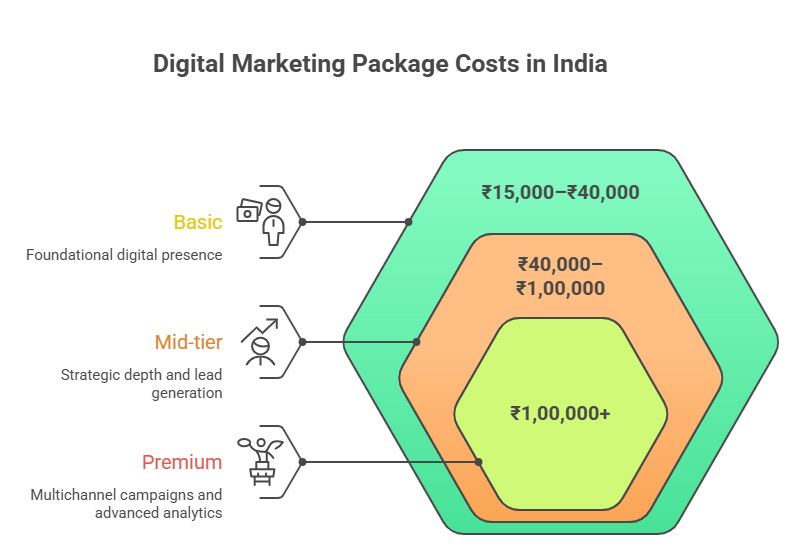
Most agencies structure their offerings into three broad tiers—basic, intermediate, and premium—each calibrated for different business stages and ambitions. Monthly digital marketing costs India typically range from ₹15,000 for foundational packages to ₹2,00,000+ for enterprise solutions, though these figures shift based on service depth and competitive intensity.
Basic packages (₹15,000–₹40,000/month) concentrate on establishing digital presence: social media management across 2-3 platforms, basic SEO with 5-10 keywords, and limited content creation. These work well for local businesses testing digital waters or startups with tight budgets prioritising visibility over aggressive growth.
Mid-tier packages (₹40,000–₹1,00,000/month) introduce strategic depth—comprehensive SEO campaigns, managed PPC advertising, email marketing automation, and consistent content calendars. A growing e-commerce brand might allocate ₹60,000 monthly here, expecting measurable lead generation and conversion improvements within 90 days.
Premium packages exceed ₹1,00,000 monthly, offering dedicated account management, multichannel campaigns, advanced analytics, and creative production. According to industry projections, India’s digital advertising market will reach ₹70,000 crore by 2026, reflecting the maturation of these sophisticated service tiers across metropolitan hubs. Enterprises competing nationally typically require this investment level, where strategy and execution complexity justify the premium.
Basic Packages: Affordable Solutions for Startups
For bootstrapped startups and small businesses testing digital waters, basic packages typically range from ₹10,000 to ₹25,000 monthly. What makes these entry-level offerings practical is their focused scope—rather than spreading resources thin, they concentrate on one or two core channels where your audience already congregates.
A standard basic package might include fundamental SEO cost India components: keyword research for 10-15 terms, on-page optimisation for five key pages, and basic local citations. Expect around eight social media posts monthly across two platforms, plus rudimentary analytics tracking. According to Digital Marketing Cost in Delhi 2026, these packages work best when aligned with specific growth milestones rather than vague visibility goals.
The trade-off becomes apparent quickly: limited scope means slower momentum. You’re building foundations—Google Business Profile optimisation, consistent posting rhythms, essential website fixes—rather than executing sophisticated campaigns. For businesses validating product-market fit or operating in hyperlocal markets, this measured approach prevents overspending whilst establishing digital presence.
However, if competitors are investing in comprehensive monthly strategies, basic packages alone won’t create meaningful differentiation beyond twelve months.
Advanced Packages: Comprehensive Strategies for Enterprises
Enterprise-level packages command ₹1,00,000 to ₹5,00,000+ monthly, reflecting the complexity of multi-channel campaigns at scale. These comprehensive strategies typically encompass sophisticated SEO audits, programmatic advertising, conversion rate optimisation, and advanced analytics dashboards. PPC cost in India at this tier often allocates ₹50,000–₹2,00,000 monthly just for ad spend, alongside strategic management fees.
What distinguishes premium packages isn’t merely budget—it’s integration. Agencies orchestrate brand storytelling across paid search, display networks, social platforms, and influencer partnerships whilst maintaining consistent messaging. Expect dedicated account teams, quarterly strategy reviews, and custom attribution modelling that traces revenue back to specific touchpoints.
One notable benchmark: enterprises investing at this level typically see 3–5x higher campaign sophistication through A/B testing infrastructure and real-time bidding optimisation.
The 70/20/10 Rule in Digital Marketing
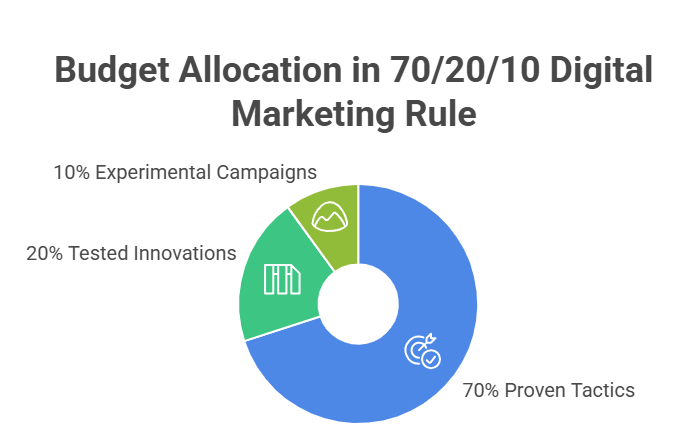
Smart budget allocation separates successful campaigns from wasteful spending. The 70/20/10 framework offers a practical approach: dedicate 70% of your budget to proven channels delivering consistent returns, allocate 20% to emerging opportunities with growth potential, and reserve 10% for experimental tactics.
In practice, a business spending ₹50,000 monthly might invest ₹35,000 in established social media marketing cost India allocations—Meta ads and Google campaigns with proven ROI. Another ₹10,000 tests newer platforms like YouTube Shorts or LinkedIn advertising, whilst ₹5, and 000 explores emerging channels such as influencer micro-partnerships or AI-powered chatbots. This distribution protects against platform volatility.
When algorithm changes impact one channel, your 70% foundation continues generating leads whilst experimental budgets identify replacement strategies. The 20% middle tier creates a testing ground for scaling future investments, allowing data-driven migration from experimental to proven channels.
However, percentages should flex based on business maturity. Startups might reverse the ratio temporarily—investing heavily in discovery whilst maintaining smaller stable budgets, before gradually shifting towards the traditional 70/20/10 split as winning formulas emerge.
Limitations and Considerations When Choosing Packages
Package-based pricing isn’t always the optimal solution, despite its apparent convenience. One critical limitation: standardised packages rarely accommodate the unique rhythms of seasonal businesses or fluctuating market demands.
Digital marketing pricing India 2026 reflects industry averages, but your specific circumstances might demand flexibility beyond rigid monthly commitments. Consider these practical constraints:
Package rigidity often locks you into services you don’t need. A restaurant might require intense social media support during festival seasons but minimal activity during slower months. Fixed packages can’t adapt to this reality.
Hidden exclusions frequently appear in fine print. Most standard packages exclude premium placements, advanced analytics tools, or crisis management support—precisely when you’ll need them most.
Performance metrics deserve scrutiny. Agencies may report “impressions” and “reach” whilst avoiding conversations about actual conversions or revenue impact. What typically happens is packages prioritise vanity metrics over business outcomes.
Contract terms matter enormously. Quarterly commitments offer reasonable testing periods, whilst annual contracts might trap you with underperforming partners. Review cancellation clauses carefully.
The most significant consideration? Packages assume your marketing needs remain static. In practice, successful businesses evolve constantly, requiring strategic pivots that pre-packaged solutions can’t accommodate.
Before committing, assess whether fixed packages align with your growth trajectory or whether customised, scalable arrangements better serve your objectives.
Future Trends in Digital Marketing Pricing in India
India’s digital advertising market is projected to reach Rs 70,000 crore by 2026, fundamentally reshaping how digital marketing agency fees India are structured. This explosive growth signals three distinct pricing shifts: performance-based models replacing fixed retainers, AI-powered automation reducing manual labour costs, and fractional specialist services enabling access to expertise previously reserved for enterprise clients.
Subscription models are gaining traction. Rather than project-based billing, agencies increasingly offer tiered monthly subscriptions with defined service levels. A basic tier might include core SEO, social management, whilst premium tiers add programmatic advertising, and advanced analytics—predictable budgeting meets scalable service delivery.
Transparency requirements are tightening as well. Clients now demand itemised breakdowns showing exactly where rupees flow: creative development versus media spend, strategy hours versus execution time. This trend towards granular accountability reflects market maturation, particularly amongst smaller businesses questioning every line item.
What typically happens is agencies adapt by offering detailed dashboards that track ROI against specific budget allocations. The rise of micro-agencies and freelance collectives creates downward pricing pressure on traditional firms, forcing established players to justify premium rates through specialisation rather than scale alone.
How much does digital marketing cost in India per month?
Monthly digital marketing budgets in India typically range from ₹15,000 to ₹2,50,000, depending on business size and campaign complexity. According to industry data, small businesses commonly invest ₹15,000–₹40,000 monthly for basic services, whilst mid-sized companies allocate ₹50,000–₹1,50,000 for comprehensive strategies.
Digital marketing services pricing varies considerably based on three key factors:
- service scope
- industry competitiveness
- geographic targeting. A Delhi-based e-commerce brand might spend ₹80,000 monthly on SEO, PPC, and social media management, whilst a local service provider could maintain visibility with ₹25,000. The distinction lies in campaign scale and platform diversity.
What actually happens in practice: businesses often start conservatively with one or two channels, then expand as they identify profitable opportunities. A common pattern shows companies allocating 40% of their budget to paid advertising, 30% to content creation, and 30% to management and analytics.
One practical approach for budget planning: calculate 7–10% of projected revenue for digital marketing spend, then adjust based on growth targets and market saturation.
Digital Marketing Packages Pricing in India
Indian agencies typically structure their offerings into three distinct tiers that align with business maturity levels. Starter packages begin around ₹15,000–₹30,000 monthly, covering essential SEO, social media management, and basic content creation—ideal for businesses testing digital channels.
Mid-tier packages range from ₹40,000–₹1,00,000 per month, incorporating multi-channel strategies with dedicated account management. These bundles often include comprehensive SEO audits, paid advertising campaigns, email marketing automation, and quarterly performance reviews.
Most businesses in this bracket allocate their annual digital marketing budget India towards sustained growth rather than sporadic campaigns. Enterprise packages exceed ₹1,50,000 monthly, offering full-service solutions with custom analytics dashboards, influencer collaborations, and strategic consulting.
What typically happens is agencies bundle services at discounted rates, a 15-20% savings compared to à la carte pricing, making packages financially attractive for businesses committing to 6-12 month contracts.
One practical approach is negotiating quarterly reviews within package agreements, allowing budget reallocation based on channel performance. Many agencies now include free website maintenance or crisis management hours as value-adds, particularly for annual commitments that demonstrate long-term partnership intent.
Key Digital Marketing Charges India Takeaways
Understanding digital marketing charges in India requires balancing budget constraints with realistic growth expectations. Monthly investments typically start at ₹15,000 for basic campaigns and scale upward based on channel complexity and competitive intensity.
Package structures align with business maturity, starter plans focus on foundational visibility, while enterprise solutions incorporate advanced tactics like influencer marketing rates India varies from ₹5,000 per post for micro-influencers to ₹5 lakhs for established creators.
The most cost-effective approach combines realistic timelines with measurable milestones, acknowledging that meaningful results emerge over 3-6 months rather than weeks. Businesses should prioritise channels where their target audience actively engages rather than spreading budgets thin across every platform.
How much does digital marketing cost in India per month?
Monthly digital marketing investments in India typically range from ₹15,000 to ₹2,00,000, depending on campaign complexity and business objectives. Small businesses often begin with basic social media management at ₹15,000-₹30,000, whilst established companies allocate ₹75,000-₹1,50,000 for comprehensive multi-channel strategies.
Meta advertising costs India businesses between ₹20,000-₹80,000 monthly for professional campaign management, including ad spend. Search engine marketing adds another ₹25,000-₹1,00,000, whilst content marketing services range from ₹18,000-₹50,000 monthly. Email marketing automation typically starts at ₹10,000 per month for basic sequences.
What determines actual costs is channel selection and competitive intensity within your industry. E-commerce brands often invest 8-12% of revenue into digital channels, whilst B2B companies allocate 6-10%. The key consideration isn’t finding the cheapest provider—it’s identifying the optimal budget allocation that balances immediate lead generation with long-term brand building across platforms.
What is the 70/20/10 rule in digital marketing?
The 70/20/10 rule provides a strategic framework for allocating digital marketing budgets across different content types, helping businesses maximise Digital marketing ROI India whilst managing risk. Under this allocation model, 70% of investment flows into proven, low-risk tactics that consistently generate results—such as ongoing SEO efforts, regular social media posts, and tested email campaigns.
The remaining 30% drives innovation and adaptation. Twenty per cent supports tested innovations, strategies that showed promise in smaller trials, like new ad formats or emerging platforms. The final 10% funds experimental campaigns, allowing brands to explore untested channels or creative approaches without jeopardising core performance.
In practice, a business spending ₹50,000 monthly might allocate ₹35,000 to established campaigns, ₹10,000 to scaling successful experiments, and ₹5,000 to testing fresh ideas. This balanced approach protects baseline revenue whilst creating opportunities for breakthrough discoveries.
What makes this framework particularly valuable is its built-in flexibility. A common pattern is adjusting these percentages as campaigns mature—new tactics that prove effective graduate from the 10% experimental bucket into the 20% category, eventually becoming part of the core 70% foundation. This systematic progression ensures marketing budgets evolve alongside market dynamics whilst maintaining stable performance.
How much does a digital marketing package cost?
Digital marketing packages in India typically range from ₹20,000 to ₹1,50,000 monthly, depending on service scope and business requirements. This pricing reflects the bundled nature of package offerings compared to à la carte services.
Starter packages (₹20,000-₹40,000) usually include basic SEO, social media management for 2-3 platforms, and monthly content creation. These suit local businesses testing digital channels initially.
Growth-focused packages (₹50,000-₹90,000) expand coverage with advanced SEO strategies, paid advertising management, email campaigns, and analytics reporting. Mid-sized companies seeking measurable expansion often select this tier.
Enterprise packages (₹1,00,000+) deliver comprehensive solutions: multi-channel campaigns, conversion optimisation, dedicated account management, and strategic consulting. However, understanding “digital marketing cost India?” requires examining what’s actually included versus flashy promises.
One practical approach is comparing value metrics—cost per qualified lead rather than total package price. A ₹40,000 package generating 50 quality leads outperforms a ₹25,000 package producing just 20 prospects.
Package structures also vary: some agencies lock clients into annual contracts with quarterly reviews, whilst others offer monthly flexibility with performance-based adjustments. What typically happens is that businesses start with mid-tier packages, then scale investment based on demonstrated ROI rather than initial budget constraints.
What is the future of digital marketing in India in 2030?
India’s digital marketing landscape is projected to exceed ₹1,00,000 crore by 2030, driven by increasing internet penetration and AI integration. The digital ad market is already set to reach ₹70,000 crore by 2026, indicating sustained momentum.
AI-powered automation will fundamentally reshape pricing structures. Tasks currently requiring manual intervention—audience segmentation, ad optimisation, content personalisation—will become increasingly automated. This shift suggests that digital marketing cost per month India will likely bifurcate: basic automated campaigns becoming more affordable (₹15,000–30,000), whilst strategic consulting commanding premium rates (₹1,00,000+).
Voice search and vernacular content will dominate. With 75% of India’s internet growth coming from regional languages, agencies investing in multilingual capabilities will capture market share. Businesses should anticipate allocating 30–40% of budgets towards regional targeting by 2030.
Privacy regulations and first-party data collection will become central to strategy. As third-party cookies phase out completely, brands building direct customer relationships will maintain competitive advantages. This evolution will increase the value of owned channels—email marketing, mobile apps, and community platforms.
Is it really worth hiring a marketing agency if you’re paying …
The value equation shifts dramatically when you compare digital marketing packages prices 2026 against in-house hiring costs. A single experienced digital marketer commands ₹50,000-₹1,20,000 monthly, whilst agencies delivering comprehensive services typically charge ₹30,000-₹80,000 for multi-channel campaigns.
However, the true differentiator isn’t price—it’s capability density. What typically happens is that agencies provide immediate access to specialists across SEO, paid advertising, content creation, and analytics without recruitment overhead. A common pattern is that businesses attempting DIY marketing spend 6-9 months reaching the competency level an agency delivers from day one.
One practical approach is evaluating your revenue-to-marketing-spend ratio. If you’re generating ₹10 lakhs monthly, allocating 15-20% to an agency makes financial sense when they consistently deliver 3:1 or better returns. Conversely, businesses below ₹5 lakhs monthly revenue often benefit more from targeted freelancer support rather than full-service packages.
Consider this: agencies absorb platform changes, algorithm updates, and tool subscriptions (often ₹15,000-₹25,000 monthly separately). They also provide accountability through structured reporting—something internal hires sometimes lack without proper management frameworks. The investment justifies itself when strategic execution consistently outperforms what scattered internal efforts achieve.
How much does it cost to hire a digital marketer in India?
Hiring a dedicated digital marketer in India typically ranges from ₹25,000 to ₹80,000 monthly, depending on experience level and skill specialisation. Entry-level marketers command ₹25,000-₹35,000, whilst specialists with 3-5 years experience demand ₹45,000-₹65,000 monthly.
Senior strategists and technical experts—particularly those handling SEO services cost India calculations, analytics, and multi-channel campaigns—often exceed ₹75,000 per month. The pricing equation shifts dramatically when factoring in statutory benefits: employers must add approximately 30-40% for EPF, ESI, and leave provisions.
However, a common pattern is that single hires rarely possess full-stack capabilities. A social media specialist won’t necessarily excel at technical SEO or PPC management, meaning businesses often require multiple team members to cover comprehensive digital strategies. This multiplies your actual talent acquisition costs considerably beyond the initial salary figure.
How much do digital marketing agencies charge in india?
Agency pricing structures vary significantly based on service combinations, with most Indian agencies offering tiered packages that bundle multiple channels. Entry-level packages typically start around ₹15,000-₹25,000 monthly for basic social media management, whilst comprehensive SEO PPC SMM packages pricing 2026 ranges from ₹40,000 to ₹150,000 depending on campaign scale and complexity.
Boutique agencies serving local businesses generally charge ₹20,000-₹50,000 monthly for integrated campaigns. Mid-tier agencies handling regional clients command ₹50,000-₹1,50,000 for multi-channel strategies. Enterprise-focused agencies servicing national brands typically structure custom packages from ₹2,00,000 upwards, often including dedicated account teams and proprietary analytics platforms.
Retainer agreements commonly include percentage-based fee structures, especially for PPC management, where agencies charge 15-20% of monthly ad spend. This model aligns agency success with campaign performance, though it increases total investment as budgets scale. However, clients must evaluate whether bundled packages deliver better value than à la carte services for their specific requirements.
How much does a professional SEO audit cost in 2026?
Professional SEO audits in India typically range from ₹15,000 to ₹1,50,000, depending on website complexity and audit depth. Basic technical audits for small websites start around ₹15,000-₹25,000, whilst comprehensive enterprise-level audits examining hundreds of pages can exceed ₹1,00,000. Mid-tier audits covering technical SEO, content analysis, and backlink profiles generally cost ₹40,000-₹70,000.
The pricing structure often reflects deliverable scope rather than time invested. Entry-level packages focus on automated tool outputs and basic recommendations, whereas premium audits include manual competitive analysis, conversion optimisation insights, and implementation roadmaps. Many agencies bundle audit costs into ongoing SEO retainers, effectively waiving separate audit fees for committed clients.
Interestingly, whilst digital marketing spend in India continues expanding, the influencer marketing cost breakdown 2026 reveals similar tiering—micro-influencer campaigns starting at ₹10,000 mirror basic audit pricing. Both services demonstrate how specialisation and scale drive substantial cost variation across digital marketing disciplines.
How much does digital marketing cost in India per month?
Monthly digital marketing costs in India typically range from ₹20,000 to ₹2,00,000, depending on business size and campaign complexity. Small businesses investing in basic social media management and content creation usually spend ₹20,000–₹50,000 monthly, whilst mid-sized companies running multi-channel campaigns allocate ₹50,000–₹1,50,000 per month.
Enterprise-level organisations with comprehensive strategies encompassing SEO, paid advertising, content marketing, and analytics often exceed ₹2,00,000 monthly. According to Matebiz’s digital marketing cost analysis, Delhi-based agencies particularly reflect this pricing spectrum, with most businesses settling into the ₹40,000–₹80,000 bracket for sustained growth-focused campaigns.
The monthly budget should align with your customer acquisition cost targets—businesses spending less than ₹25,000 monthly typically see limited results, as this barely covers basic social media presence. However, spending beyond ₹1,50,000 without proper attribution tracking often leads to wasted investment, making the ₹50,000–₹1,00,000 range the sweet spot for most growing Indian businesses seeking measurable ROI.
Digital Marketing Packages Pricing in India
Understanding digital marketing costs empowers businesses to make informed decisions that align with their growth objectives and budget constraints. The landscape in 2026 offers diverse pricing models—from monthly retainers to performance-based arrangements—each suited to different business stages and marketing ambitions.
Your investment should reflect both immediate campaign needs and long-term brand building goals. Starter packages beginning around ₹20,000 monthly provide essential visibility, while comprehensive strategies demanding ₹2, 00, and 000 or more deliver multi-channel dominance.
The key is matching service depth to business maturity: emerging brands benefit from focused single-channel efforts, whilst established enterprises require integrated campaigns spanning SEO, paid media, and content marketing. Don’t fixate solely on price, evaluate agency expertise, reporting transparency, and strategic alignment.
Request detailed breakdowns showing exactly where your rupees go, from content creation hours to ad spend allocation. Track meaningful metrics beyond vanity numbers: conversion rates, customer acquisition costs, and revenue attribution matter more than follower counts.
Conclusion
The right digital marketing partnership transforms spending into strategic investment. Start with clear objectives, communicate budget boundaries openly, and choose partners demonstrating proven results in your industry. As India’s digital advertising market approaches ₹70,000 crore by 2026, businesses positioning themselves strategically now will capture disproportionate market share tomorrow.