
Latest Google Algorithm Updates in 2026: How Google Search Works and What Businesses Must Know
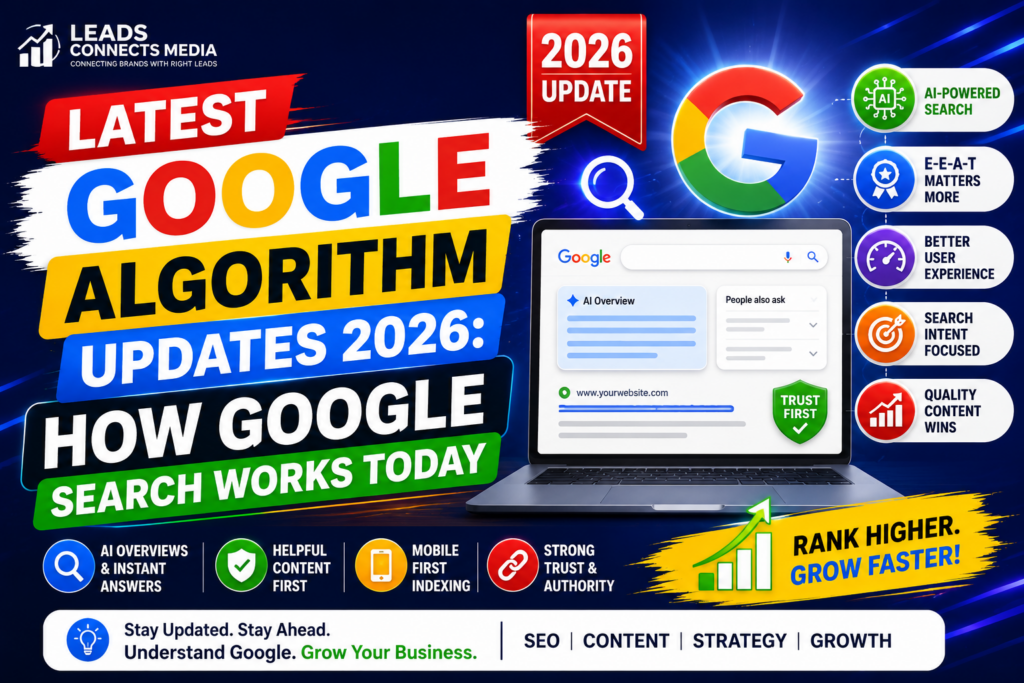
Google algorithm updates its search algorithm thousands of times every year. While many of these changes are small, some updates significantly impact website rankings, traffic, and online visibility. In the 2026, Google continues to focus on providing users with the most powerful and helpful, trustworthy, and relevant content while integrating AI-powered search experiences.
If you own a business website, blog, or eCommerce store, understanding how Google’s algorithm works is no longer optional—it’s essential for long-term online success.
Let’s explore the latest Google algorithm updates and how they affect your website.
What Is Google’s Search Algorithm?
Google algorithm is a complex system that evaluates billions of web pages to determine which results should appear when someone performs a search.
The algorithm considers hundreds of ranking factors, including:
- Content quality
- User experience
- Website speed
- Mobile friendliness
- Backlinks
- Search intent
- Content freshness
- Author expertise
- Trust signals
Its primary goal is simple: deliver the best possible answer to the user’s query.
Major Google Algorithm Trends in 2026
1. AI-Powered Search is Becoming the New Standard
Google’s AI-driven search experience has transformed how users discover information.
Instead of showing only traditional blue links, Google now provides:
- AI-generated summaries
- Instant answers
- Contextual recommendations
- Follow-up questions
- Multi-step search assistance
This means websites must optimize not only for traditional SEO but also for Generative Engine Optimization (GEO).
Example:
If someone searches:
“Best digital marketing strategy for small businesses”
Google may generate an AI overview that combines information from multiple trusted websites before displaying organic results.
Websites that provide clear, authoritative, and structured content have a better chance of being featured.
2. Helpful Content Remains a Top Ranking Factor
Google continues rewarding content created for people rather than search engines.
Many websites still publish articles filled with keywords but offer little value.
Google now identifies:
✅ Original insights
✅ Real-world experience
✅ Expert opinions
✅ Practical examples
And reduces visibility for:
❌ AI-generated spam
❌ Thin content
❌ Duplicate articles
❌ Keyword stuffing
The message is clear: write for humans first.
3. Experience, Expertise, Authority, and Trust (E-E-A-T)
Google algorithm places increasing importance on E-E-A-T.
This framework evaluates whether content comes from trustworthy sources.
Websites should demonstrate:
- Real industry experience
- Author credentials
- Company information
- Customer reviews
- Transparent policies
For example, a digital marketing agency publishing SEO advice should showcase actual client success stories and case studies.
This helps build credibility with both users and search engines.
4. User Experience Signals Matter More Than Ever
Google wants visitors to have a smooth experience after clicking a search result.
Important factors include:
Page Speed
Fast-loading websites tend to perform better.
Mobile Optimization
Most searches now happen on mobile devices.
Easy Navigation
Users should quickly find the information they need.
Low Bounce Rates
If visitors leave immediately, Google may interpret this as a poor user experience.
A modern, user-friendly website often gains an advantage over competitors with outdated designs.
5. Search Intent Is More Important Than Keywords
In the past, ranking often depended on placing exact keywords throughout content.
Today, Google focuses on understanding what users actually want.
For example:
A search for:
“How to start digital marketing”
indicates educational intent.
While:
“Best digital marketing agency near me”
shows commercial intent.
Creating content that matches the user’s intent is now more important than repeating keywords multiple times.

What Is GEO (Generative Engine Optimization)?
Generative Engine Optimization (GEO) is becoming one of the biggest digital marketing trends in 2026.
GEO focuses on optimizing content for AI-driven search platforms such as:
- Google AI Search
- ChatGPT Search
- Gemini
- Perplexity AI
- Microsoft Copilot
Instead of ranking only on traditional search results, GEO helps content get referenced by AI-generated answers that is also new Google algorithm.
GEO Best Practices:
- Use clear headings
- Answer questions directly
- Include statistics and examples
- Add FAQ sections
- Build topical authority
- Maintain content accuracy
- Update articles regularly
Businesses that adapt early to GEO will gain a significant competitive advantage.
Real Example: How Google Evaluates Content Today
Imagine two websites publishing an article about SEO.
Website A
- 500 words
- Keyword stuffed
- No examples
- No author information
Website B
- 2,000+ words
- Real case studies
- Expert insights
- Updated statistics
- FAQ section
- Fast-loading website
Google will almost always favor Website B because it provides more value to users.
This demonstrates why quality consistently beats quantity.
How Businesses Can Stay Safe During Google Updates
Google algorithm and updates can cause ranking fluctuations, but businesses following best practices usually recover quickly.
Focus On:
✔ High-quality content
✔ User experience
✔ Technical SEO
✔ Mobile optimization
✔ Natural backlinks
✔ Regular content updates
✔ GEO optimization
Avoid:
✖ Buying backlinks
✖ Duplicate content
✖ Spammy AI content
✖ Keyword stuffing
✖ Manipulative SEO tactics
Final Thoughts
Google algorithm in 2026 is smarter than ever. The focus has shifted from simply ranking websites to delivering the most helpful and trustworthy information through both traditional search results and AI-generated experiences.
Businesses that prioritize user experience, valuable content, E-E-A-T principles, and GEO strategies will be better positioned to succeed in the evolving search landscape.
At Leads Connects Media, we help businesses adapt to the latest Google updates through advanced SEO, GEO optimization, content marketing, and digital growth strategies. As search continues to evolve, staying updated and focusing on quality will remain the most effective path to long-term rankings and sustainable online growth.
Great content! Keep up the good work!
Very nice post, helpfull