
In 2026, launching a digital marketing business from home is no longer about trading time for money. It is about building a scalable, AI-powered system that delivers measurable results.
To succeed, you must shift your mindset from a solitary freelancer to a disciplined agency owner who prioritizes efficiency, data-driven decisions, and sustainable profit margins.
The 2026 Mindset: Shifting from Freelancer to Agency Owner
Why Now is the Best Time to Launch a Home-Based Agency
The barrier to entry is lower than ever, yet the demand for expert navigation of the complex digital landscape has peaked. Businesses are desperate for partners who can translate technical chaos into clear, revenue-generating growth.
The “Operator’s Edge”: Building a Workflow-First Business
Success depends on your internal operations. By prioritizing standardized workflows, you ensure consistency, which is the cornerstone of scaling. Treat every task as a repeatable process to maintain high quality as your client list grows.
Transitioning from a Skill-Based Service to a Revenue-Based Solution
Move away from selling “tasks” like social media posts. Instead, sell outcomes. Position your service as an essential investment in the client’s financial growth.
Defining Your Profitable Niche and Target Audience
Conducting Market Research to Identify Service Gaps
Use keyword research to identify high-intent queries where competitors are failing. Look for underserved industries where a tailored, expert approach can dominate the conversation.
Focusing on High-Value Verticals: E-commerce, Local SEO, and B2B SaaS
Focus on verticals with clear, quantifiable value. These sectors prioritize data, making them ideal for performance-based marketing.
Understanding Search Intent and Customer Behavior in Your Chosen Niche
Deeply analyze your target audience. Understanding why a customer searches for a specific term allows you to align your content with their intent, driving higher conversions.
Building Your 2026 AI-Integrated Operating System
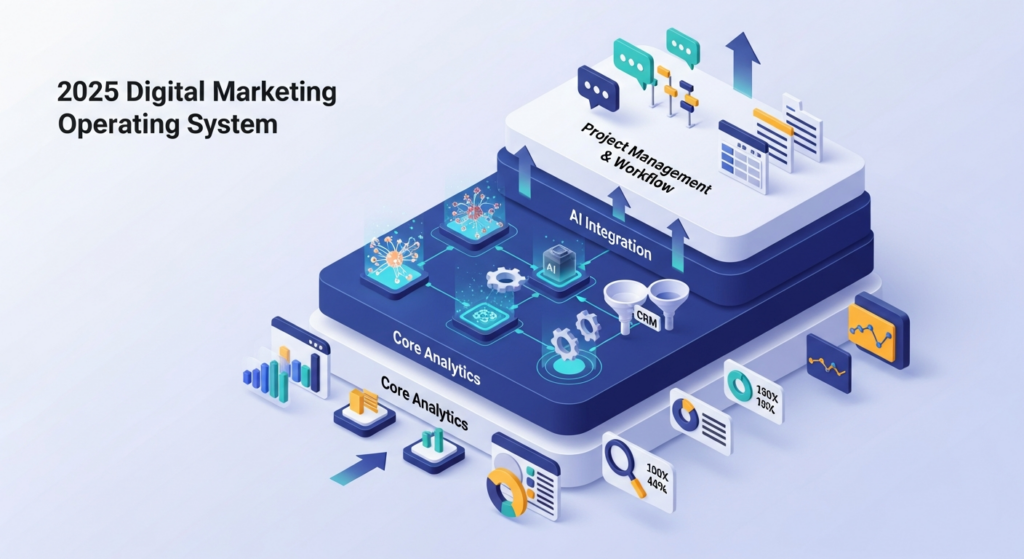
The three interconnected pillars of a modern, highly scalable digital marketing business agency operating system.
Core Analytics Foundation: Setting Up Google Analytics 4 and Search Console
Every website you manage must be anchored in Google Analytics 4 and Search Console. These are your non-negotiable tools for tracking analytics and proving ROI.
AI Integration: Using AI for Content Research, CRM Management, and Automation
Leverage AI to handle mundane tasks. Use it to synthesize market data, manage email sequences, and optimize repetitive workflows, allowing you to focus on strategy.
Project Management and Workflow Tools (CoSchedule, Google Sheets, and Slack)
Centralize communication and tasks. Using a unified system ensures no project detail is lost, keeping your Numbers transparent and your team aligned.
Developing Your Core Service Menu (Productization)
Modern Search Engine Optimization: Technical SEO and Local SEO for Small Digital Marketing Business
Optimize each site for speed and intent. Ensure local businesses are listed correctly in every relevant directory to maximize visibility.
Content Marketing: Creating High-Authority Blog Posts and Custom Illustrations
High-quality blog posts remain the gold standard. Enhance your content marketing strategy with original graphics and data-driven insights that others want to cite.
Social Media Marketing: Mastering Meta Ads Manager and TikTok for Lead Gen
Social platforms are vital for community engagement. Use them to amplify your brand’s reach through targeted paid and organic campaigns.
Email Marketing: Designing Automated Campaigns and Drip Sequences
Automation is key. Use drip sequences to nurture leads, turning one-time visitors into repeat customers. leads to digital marketing business.
The Growth Engine: High-Impact Link Building and Visibility
Leveraging HARO and Digital PR for Brand Awareness
For digital marketing business build your brand by becoming an industry authority.
Image Link Building: Using Infographics and Data Visualizations for Backlinks
Use Infographics to simplify complex data. These assets are highly linkable, naturally earning high-quality backlinks and boosting domain authority.
Guest Posting and Strategic Outreach Using Link Building Outreach Templates
Manual outreach is essential. Use personalized templates to secure placements on reputable sites.
Improving Domain Authority through High-Authority Referring Domains
Focus on quality over quantity. Every link from a reputable source significantly strengthens your SEO.
Mastering Client Acquisition and Sales
Developing a Lead Magnet: Free Consultations and Website Audits
Offer value upfront. A free audit is the perfect way to demonstrate expertise and secure a meeting.
Calculating Customer Acquisition Costs (CAC) for Your Own Agency
Know your Numbers. Tracking CAC ensures your growth remains profitable.
Managing Marketing Budgets: How to Allocate Funds for Maximum Growth
Reinvest profits into your own lead generation and tech stack.
Outreach Strategies: Cold Email, Networking, and LinkedIn Presence
Be present where your clients are. Build relationships through consistent, helpful engagement.
Pricing Your Services for Profitability
Hourly vs. Project-Based vs. Monthly Retainer Models
Retainers provide the stability required to grow. Prioritize them for long-term health.
Conclusion
Transitioning to an digital marketing business agency model requires moving beyond technical execution to become a strategic partner. Focus on high-value services, leverage AI to streamline operations, and always anchor your work in measurable data.
By maintaining this professional, ROI-focused approach, you will build a resilient and scalable digital marketing business business that stands the test of time in the competitive 2026 landscape. Start by auditing your current workflow, then optimize for efficiency to unlock your true growth potential.